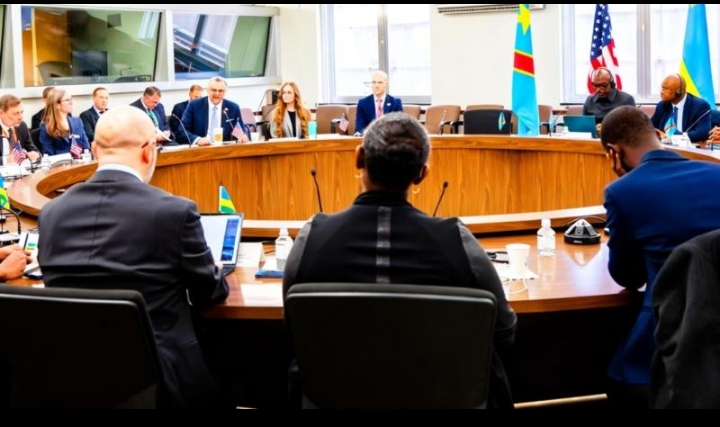
Rwanda and the Democratic Republic of the Congo (DRC) have reaffirmed their commitment to accelerating efforts to dismantle the Democratic Forces for the Liberation of Rwanda (FDLR) during the fifth meeting of the Joint Security Coordination Mechanism (JSCM) held in Geneva, Switzerland.
The meeting, which took place on July 15–16, 2026, brought together delegations from Rwanda, the DRC, the United States, Qatar, Togo, and the African Union Commission (AUC) to assess progress in implementing the Washington Peace Agreement, particularly measures aimed at restoring peace and security in eastern DRC.
According to a statement released by the United States, both Rwanda and the DRC reaffirmed their determination to implement the commitments made under the agreement, including accelerating the dismantling of the FDLR and addressing the security concerns that prompted Rwanda to adopt defensive measures along its border.
The FDLR, an armed group founded by individuals responsible for the 1994 Genocide against the Tutsi who fled to the DRC, continues to be regarded as one of the main sources of instability in eastern Congo and a significant security threat to Rwanda, as highlighted in reports by the United Nations Group of Experts.
The UN report notes that the FDLR operates through three main factions: FDLR-FOCA, FDLR-RUD, and FDLR-FPP. To evade detection while continuing their activities, these factions have adopted new identities.
FDLR-FOCA now operates under the name “Bataillon Jungle,” FDLR-RUD identifies itself as “FDP-R,” while FDLR-FPP continues using the name “FPP.”
Although the group claims to have more than 10,000 fighters, and its CRAP branch claims over 20,000 members, UN experts and intelligence assessments estimate the actual number of combatants to be between 3,500 and 4,500.
The report also indicates that despite the Congolese Armed Forces (FARDC) announcing in March 2026 an operation to eliminate the FDLR, UN experts found the objective difficult to achieve, noting that some FDLR members continue to cooperate with FARDC forces or have been integrated into Wazalendo armed groups.
To strengthen implementation of the Washington Peace Agreement, all participating parties agreed to establish a robust monitoring and verification mechanism to oversee the execution of agreed measures, enhance accountability, and build confidence among stakeholders.
Participants also received a briefing from MONUSCO on ongoing disarmament, demobilization, reintegration, and repatriation (DDRR) efforts, particularly those targeting former FDLR combatants, which are considered essential to achieving sustainable peace in the region.
The meeting concluded with Rwanda and the DRC pledging to continue sharing security intelligence and strengthening cooperation in implementing the Washington Peace Agreement, which is widely viewed as a significant step toward promoting lasting peace and stability in the Great Lakes region.
Rwandatribune.rw