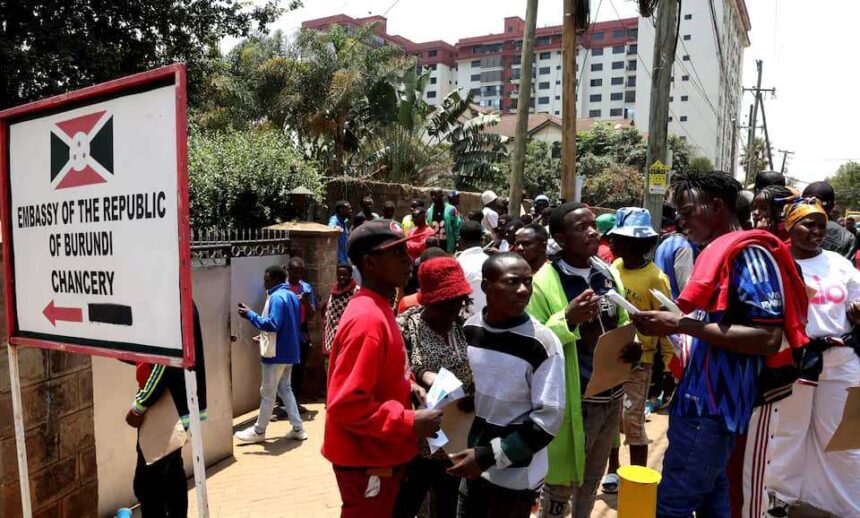
The Kenyan government has given East African citizens living in the country without valid legal documents a temporary window to regularize their status, following concerns among hundreds of Burundians who gathered at the Burundian Embassy in Nairobi fearing deportation or possible penalties.
The decision came after Kenyan President William Ruto announced that his government would step up enforcement against foreign nationals operating small businesses without the required permits.
On Monday, September 7, 2026, large numbers of Burundians gathered at the Burundian Embassy in Nairobi.
Some arrived carrying suitcases and other personal belongings, seeking travel documents that would enable them to return to Burundi.
Some said President Ruto’s remarks had caused anxiety, with several reporting that they had begun facing intimidation from people in their neighborhoods.
However, there were no major reports in Nairobi that day of authorities shutting down foreign-owned businesses or carrying out widespread arrests.
Last week, President Ruto directed relevant authorities to stop small-scale businesses operated by foreign nationals in Kenya, particularly those operating without the required permits.
The announcement followed a meeting between Ruto and Kenyan traders who had for days been expressing dissatisfaction with changes to the country’s tax system.
The Ministry of Trade clarified that the measures were primarily targeting foreigners engaged in business activities without the permits required to operate legally in Kenya.
Amid the concerns, a spokesperson for President Ruto’s administration said the Kenyan government would not tolerate violence, intimidation or discrimination based on a person’s nationality.
The government has encouraged East African citizens without proper documentation, particularly Burundians, to register with their respective embassies.
It said anyone who registers under the programme will be considered to be in Kenya legally while the registration process is ongoing.
A government spokesperson said the initiative is intended to allow affected individuals to access essential services, including healthcare, banking services and legal protection, without fear of arrest.
The government also said the process of regularizing documentation would be carried out in cooperation with other countries in the region.
According to the United Nations High Commissioner for Refugees (UNHCR), Kenya hosts around 16,000 Burundians, including refugees and asylum seekers.
Many of them engage in small-scale businesses in Nairobi, selling various goods, including coffee and second-hand clothes.
Munezero Farnke, an 18-year-old who went to the Burundian Embassy, said Burundians should have been given time to prepare before being required to return home.
“They should at least give us a week to prepare and return to Burundi, or help us reach the border. I have been here for three years without an identity card, and I had planned to return home next year,” he said.
Peter Nakumujango, 62, who was also among those waiting at the embassy, said he had not planned to return to Burundi at that time.
“There are so many people here, and we do not know when we will receive assistance. I am not returning home voluntarily. I am being forced to leave,” he said.
So far, the Burundian Ambassador to Kenya and the government of Burundi have not issued public statements on the situation.
Critics of President William Ruto argue that his government could be shifting attention toward foreign nationals as Kenya struggles with economic challenges.
The developments come as Kenya prepares for presidential elections scheduled for next year, with Ruto expected to seek another term in office.
Hanifa Adan, a human rights activist, recently wrote in the Daily Nation that when a country fails to find solutions to major economic problems, it may begin looking for someone to blame.
“When a country has no answers to a collapsing economy, it often starts looking for an enemy,” she wrote.
Ruto Orders Indian Company to Halt Operations
In a separate decision involving foreign businesses, President Ruto announced on September 3, 2026, that India’s Tata Chemicals should halt its operations in Kenya.
Ruto said the company’s activities had not generated sufficient benefits for Kenya, particularly in terms of industrial development and the economic development of Kajiado County, where Tata Chemicals extracts soda ash.
Tata Chemicals said it respects the authority of the Kenyan government and remains willing to continue discussions through legally established channels in an effort to resolve the dispute.
BARAKA Esther
Rwandatribune.rw